


The Wall of Resumes Problem Every Hiring Team Knows
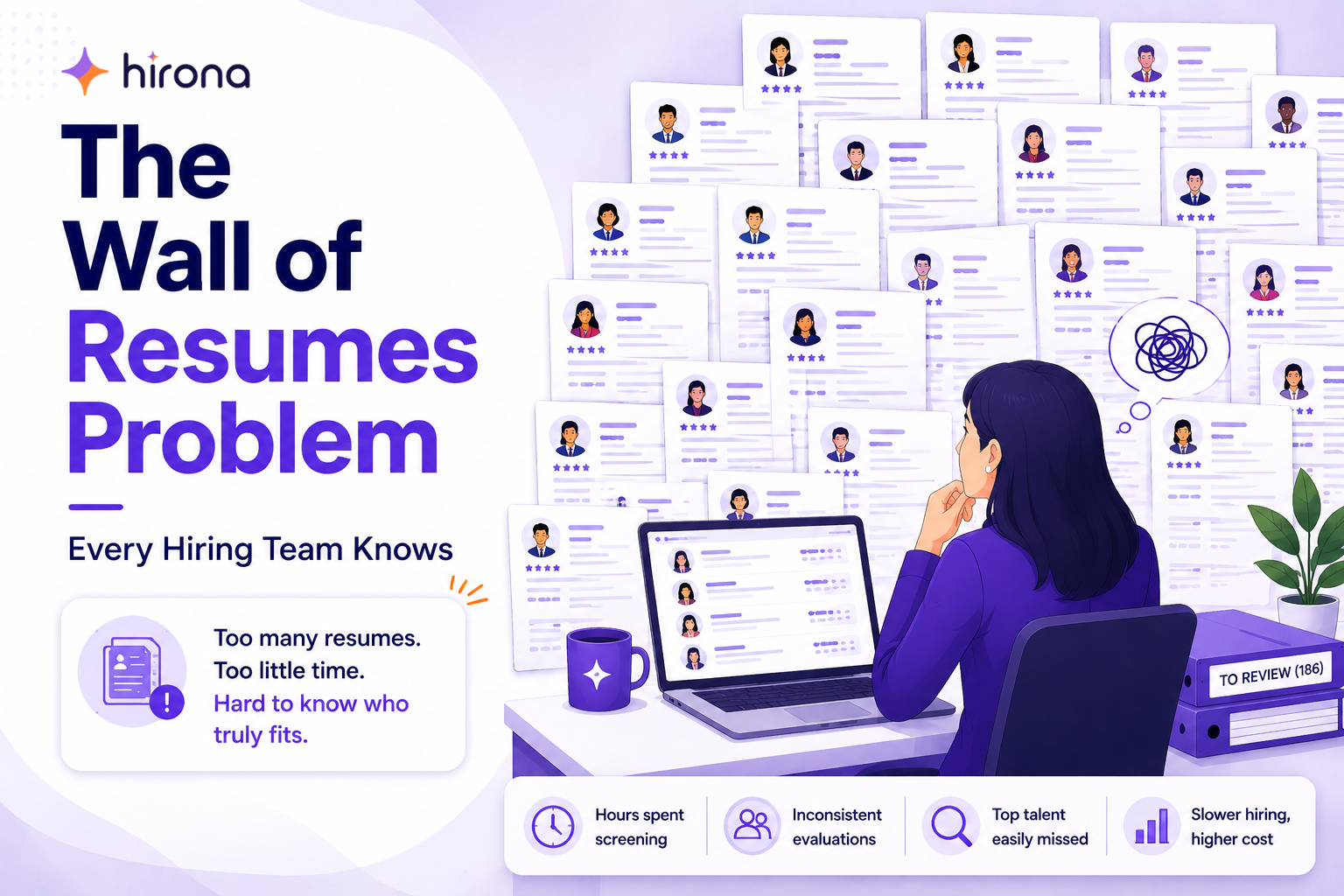
Every hiring team has felt this moment: a role goes live, and within days there are 40, 100, 200 applications sitting in an inbox. Somewhere in that pile is exactly the right person. Finding them means reading through everyone else first, one at a time, usually squeezed between everything else on someone's plate that week.
This is the part of hiring that rarely gets talked about at conferences, the unglamorous stretch between "job posted" and "first real conversation," where good candidates quietly wait, and where the person doing the screening is making judgment calls faster and faster as the pile grows, whether they mean to or not.
Why this stage is harder than it looks
Screening feels like it should be simple: read the resume, decide if it's a fit. In practice, it's inconsistent by nature. The tenth resume of the day gets a different level of attention than the first. A candidate with an unconventional background or a career change can get filtered out in seconds, not because they weren't qualified, but because a quick skim isn't built to catch nuance.
None of this is a failure of the people doing it. It's a structural problem: asking a human to apply a consistent, careful standard to hundreds of applications, one after another, is asking for something human attention was never really built to sustain.
What a different first screen looks like
The alternative isn't reading faster or hiring more screeners. It's changing what the first pass actually is. Instead of a resume being read and judged in isolation, every candidate gets the same structured interview, the same questions, evaluated against the same bar, whether they're the first applicant or the two hundredth.
That consistency is the real shift. A shortlist built this way reflects an actual, comparable evaluation of every candidate, not a series of increasingly rushed judgment calls made across a long afternoon.
Seeing it in person
It's one thing to describe this. It's more convincing to watch a stack of applications turn into a clean, ranked shortlist in real time, which is exactly what we'll be showing at our booth this year: the two sides of this problem, side by side, and a live look at how the gap between them closes.
If hiring volume, screening consistency, or just the general chaos of a growing applicant pile sounds familiar, come find us at the show. We'd rather show you than explain it in a paragraph.