)
)
)
How to Get Your Website Cited In Google AI Overviews
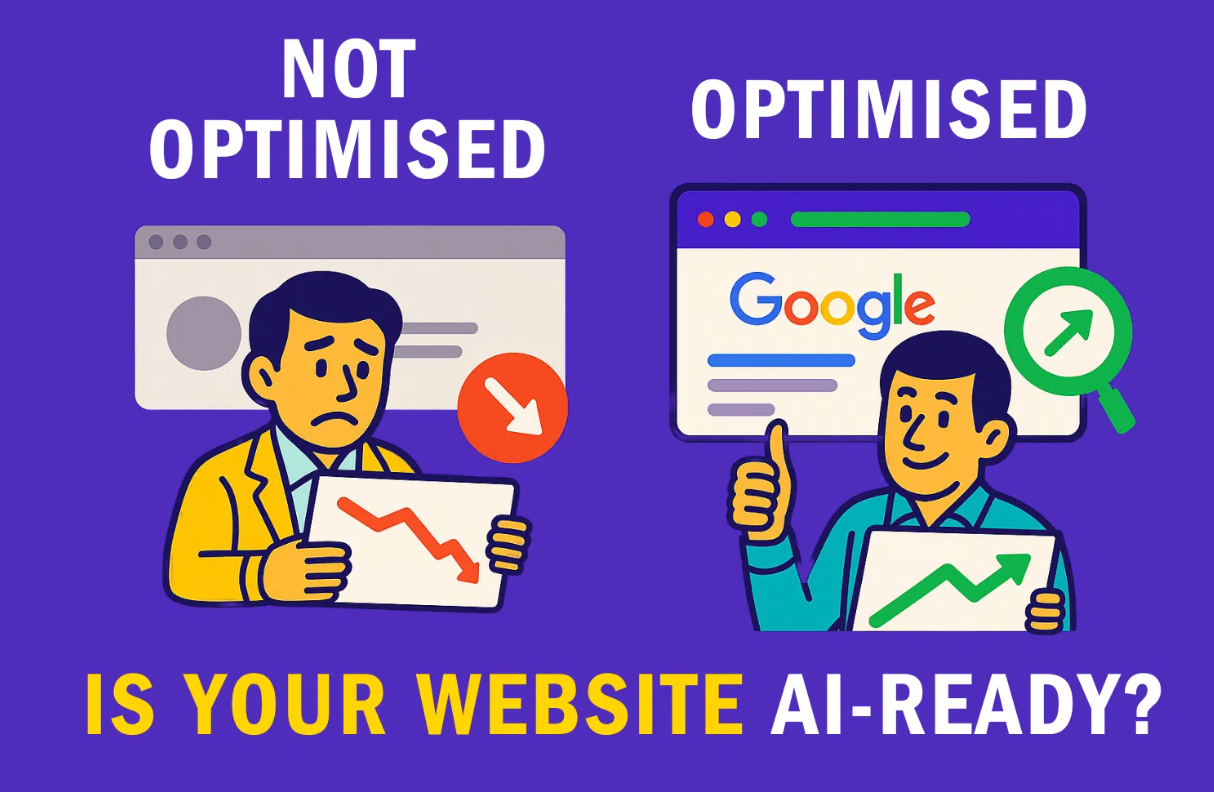
What is Google AI Overview?
Google AI Overview is an AI-generated summary that appears at the top of Google’s search results — above ads and organic links.
Instead of listing websites, Google uses AI to pull information from trusted sources and present a concise answer on the search page.
Launched in Singapore in November 2023 as part of Google’s Search Generative Experience (SGE), AI Overviews are most common for informational and commercial-intent searches like:
- “Hydrafacial vs chemical peel”
- “Best preschool curriculum Singapore”
The result? Users get their answers instantly, without clicking a single link.
Where does Google AI Overview get its information from?
Google AI Overview pulls information from websites it trusts — sites with clear, high-quality content that its AI can easily scan and summarise.
Though AI Overview changes how search results appear, strong SEO fundamentals still matter. In fact, research shows that 23.6% to 48.1% of the sites it features also rank in the top 10 organic results.
Here’s what Google looks for:
- Clear, high-quality content writing in natural, human-friendly language
- Topical authority, built through internal linking and in-depth coverage of a topic
- E-E-A-T: Experience, Expertise, Authoritativeness, Trustworthiness
- Schema markup, like “FAQPage”, “Article”, or “LocalBusiness”, to help AI understand your content structure
- Strong UX: fast loading, mobile-optimised, and easy to navigate
Pro Tip: If you’re missing any of these, Google’s AI may not even register your content — much less summarise it.
What types of websites does Google AI Overview prioritise?
Google’s AI tends to favour websites that demonstrate authority, trust, and comprehensive coverage of any given topic. Such websites include:
- High domain authority sites (e.g. Wikipedia, Mayo Clinic)
- Government or academic institutions (e.g. gov.sg, nus.edu.sg)
- Industry leaders with deep topical coverage
But smaller businesses aren’t out of the game. Local companies and niche specialists can show up for:
- Location-specific queries (“Best dermatologist Singapore”)
- Commercial comparisons (“Ultherapy vs Thermage”)
- Industry pain points (“Preschool for speech delay Singapore”)
Should your business aim to appear in Google AI Overview?
Yes, but strategically. Not every keyword is worth chasing, so you shouldn’t aim for AI Overview with branded or ultra-competitive keywords as it won’t drive meaningful business.
Instead, go for mid-funnel searches where people are comparing, researching, or evaluating options.
This is where AI Overview can turn curiosity into leads, especially for businesses in education, health, aesthetics, tech, or services.
Pro Tip: The goal isn’t just to show up. It’s to show up where it matters — where your content can actually influence a buying decision.
What search intent triggers Google AI Overview?
AI Overview tends to appear when users want quick, reliable answers — not necessarily when they’re ready to buy.
Here are the 4 main types of search intent that commonly trigger AI Overview:
| Intent Type | What the user wants | Example (Singapore) |
| Informational | To learn or understand something | “What is a Montessori curriculum?” |
| Commercial | To compare, research, or evaluate before buying | “Coding bootcamp vs diploma Singapore” |
| Navigational | To find a specific brand or place | “NTUC Health Toa Payoh reviews” |
| Transactional | To take action or make a purchase | “Hair transplant price Singapore” |
Editor’s Note: These definitions follow industry standards but have been localised for the Singapore market, particularly with examples that reflect local search behaviour and the navigational intent category.
If your content addresses these types of questions, and does so clearly, quickly, and in a structured format, you’re halfway there.
Pro Tip: Use question-based content like “X vs Y” or “Best [service] for [audience].” That’s what both AI — and searchers — love.
When can your site realistically appear in Google AI Overview?
Let’s be honest: you won’t outrank Wikipedia for a search like “What is skincare?” But your site can appear in AI Overview for searches with:
- Cost-related keywords: “Laser hair removal cost Singapore”
- Comparison searches: “Hydrafacial vs microneedling”
- Location-specific queries: “Best TCM clinic Tampines”
- Service-specific pain points: “Preschool for speech delay Singapore”
Pro Tip: Add specifics — like location, cost, and real-life examples — to your content. That’s what Google AI looks for when choosing sources.
How to optimise for Google AI Overview
To win a spot in AI Overview, you need to optimise your content in 2 key ways:
- Be structured in a way that Google’s AI can easily understand
- Be genuinely useful for users
Here’s how to make that happen:
-
Structure your website like an AI SEO pro
Google’s Search Central recommends creating content that is easy for both users and search engines to navigate. AI models prefer structured, scannable information.
Here are some best practices:
- Use clear H1-H3 headers to break content into logical sections
- Start with a summary or TL;DR — this is often the first part AI will extract
- Break up dense text with bullet points, FAQs, and tables
- Use internal links between related pages to build content depth
-
Align your content to the right search intent
Effective content isn’t just about answering questions. It’s about answering the right questions at the right stage of a customer’s journey.
Here’s a simple content mapping framework:
- TOFU (Top of Funnel): Awareness content, like educational blogs for search terms like “What is Ultherapy?” (educational blog)
- MOFU (Middle of Funnel): Comparison or consideration — “Ultherapy vs Thermage” (in-depth guide)
- BOFU (Bottom of Funnel): Transactional — “Ultherapy clinic near me” (service page with booking info)
Pro Tip: Aligning content with intent increases the chance that your site will be summarised for relevant queries, especially those with commercial value.
-
Use schema markup
Schema markup provides structured data that helps Google parse your content. According to Google Search Central, it “enhances your content’s eligibility for rich results in search,” which extends to AI Overviews.
Schema types you should use:
| Schema Type | What it’s for | Real-Life Example |
| FAQPage | For pages with FAQs | A dental clinic answering “Is Invisalign painful?” |
| Article | For blogs and news articles | A preschool blog on “Montessori vs Reggio Emilia” |
| LocalBusiness | For businesses with a physical location | A TCM clinic listing hours, address, contact info |
| Product | For services or offerings | A medspa showcasing Pico Laser Treatment with price and reviews |
How to implement schema markup
- Use a Schema Markup Generator: Tools like Technical SEO’s Generator simplify this process
- Manually add JSON-LD to your page: This is the format Google recommends
- Use plugins if you’re on a CMS: Plugins like Yoast SEO or Rank Math for WordPress
- Validate with Google’s Rich Results Test: Always check your markup before publishing
Pro Tip: Get all your basics from Google Search Central to learn more about structured data and how to implement schema correctly. Following Google’s guidelines ensures your markup supports both rich results and AI Overview eligibility.
-
Build topical authority
- Link related blogs to service pages and vice versa
- Group content into clusters around each key topic
- Don’t let blog posts float in isolation — tie them to a revenue goal
Why E-E-A-T and schema markup are non-negotiable?
Google AI Overview prioritises content it can trust and understand. This is where E-E-A-T and schema markup come in.
E-E-A-T stands for Experience, Expertise, Authoritativeness, and Trustworthiness. It’s Google’s way of asking, “Can I trust this site to give the right answer?” And if you’re writing about sensitive or high-stakes topics — like health, education, finance, or property — E-E-A-T is non-negotiable.
Here’s how to do it:
- Add expert bios and credentials
- Include real photos, case studies, or client testimonials
- Link to media mentions, awards, or certifications
- Keep content up to date
Schema markup tells Google what your content is and who it’s for. Without it, even the best content can be ignored by AI Overview.
Pro Tip: If you’re HCSA-regulated in Singapore, use doctor bios, research-backed content, and structured FAQs while staying compliant.
What makes AI SEO different from traditional SEO?
If you’re still only optimising for keywords and backlinks, it’s time to update your playbook.
Here’s the difference:
| AI SEO | Traditional SEO |
| Focuses on search intent and structure | Focuses on keyword density |
| Optimises for AI models and natural language readers | Optimises for bots |
| Prioritises trust signals and structured data | Prioritises backlinks |
| Targets visibility in summaries | Targets rankings |
RELATED: The Definitive Guide to Keyword Research for SEO
Key difference: AI SEO vs traditional SEO
Traditional SEO aims for position on page one while AI SEO aims to be chosen as part of AI-generated answers.
This means you’ll need to prioritise structure, clarity, trust, and schema — not just keyword density and link-building.
How AI SEO benefits ChatGPT and other AI tools too
Google’s not the only one summarising your website. AI platforms like ChatGPT, Bing Copilot, and Perplexity AI increasingly pull live web data to answer user queries.
If your content is structured, cited, and trustworthy, it’s more likely to be featured in AI-generated answers — whether that’s in a chat, search engine, or voice assistant.
Pro Tip: Write your content as if explaining to a knowledgeable human assistant. Clear answers, structured points, and cited sources help your content get surfaced by AI tools.
Final checkpoint: Is your website AI-ready?
Here’s your AI SEO checklist:
- Are your pages structured with H1-H3 headings, summaries, and bullet points?
- Are you targeting high-intent commercial or comparison queries?
- Have you implemented E-E-A-T with bios, credentials, reviews?
- Is schema markup applied to key pages (and validated)?
- Are your blog and service pages internally linked by topic clusters?
- Is your site mobile-optimised and fast-loading?
Get featured in Google AI Overview and turn traffic into leads
At Heroes of Digital, an SEO agency in Singapore, we’ve helped over 600 businesses in Singapore, across various industries, drive high-quality leads with content that Google trusts. Our proven approach blends content strategy, schema implementation, and E-E-A-T optimisation, which ensures your website is AI-ready and positioned to capture real ROI.
Ready to make your website the answer AI delivers? Fill in the form below to get a free proposal from us or drop us a message on WhatsApp by clicking the WhatsApp button at the bottom-right corner of the screen.
Frequently asked questions about Google AI Overview and ChatGPT
Can I apply for my website to show up in Google AI Overview?
No, you can’t apply for it. Google AI Overview selects content automatically based on its quality, relevance, and trustworthiness. The best way to get featured is to create helpful, well-structured content that meets Google’s standards.
How can I get my website featured in Google AI Overview?
Focus on publishing clear, useful content that answers real search queries. Your content should align with search intent, include schema markup, follow E-E-A-T guidelines, and build topical authority with internal links. The better your content meets these criteria, the higher your chances of being featured.
What kind of searches trigger Google AI Overview?
AI Overview typically appears for queries where users want quick, reliable answers — especially informational, comparison, or commercial-intent searches. For example: “What is a Montessori curriculum?” or “Hydrafacial vs microneedling Singapore.”
Is Google AI Overview legit?
Yes, Google AI Overview is a legitimate feature of Google’s Search Generative Experience (SGE). It uses AI to summarise information from trusted websites, helping users get accurate answers from reputable sources without having to click around.
What’s the difference between Google AI Overview and ChatGPT?
Google AI Overview summarises existing web content in response to a search. ChatGPT creates responses based on its training data and sometimes real-time information. If your content is structured, authoritative, and answers common questions clearly, it can be featured in both.